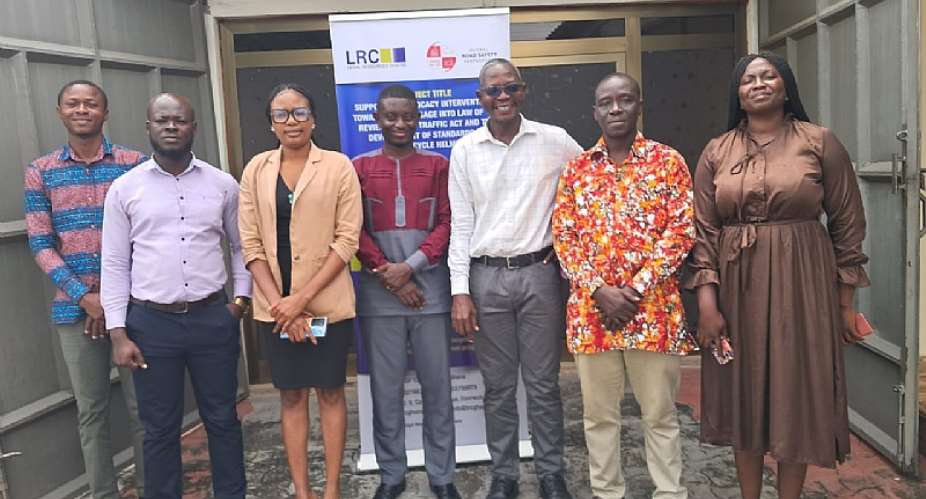
The Legal Resources Centre (LRC), in collaboration with the National Road Safety Authority (NRSA) and Vital Strategies, has held the second edition of its Road Safety Journalism Training in Accra, with a focus on empowering journalists to lead the charge in road safety advocacy.
The training, which comes at a time when Ghana is grappling with a surge in road crashes, placed special emphasis on speed management and the urgent need to develop Ghana-specific motorcycle helmet standards. Both issues form part of broader advocacy efforts for the review and passage of Ghana’s Road Traffic Act.
Speaking at the event, Mr. Enock Jengre, Programme Officer at the Legal Resources Centre, underscored the importance of joint advocacy and stressed the critical role journalists play in amplifying key messages to the public and policymakers.
“We can only speak, but the journalists have the space and the voice to take these issues to the public and to policymakers,” he said.
He revealed alarming statistics showing that road crashes in Ghana increased significantly in the first half of 2025 compared to the same period in 2024. Motorcycle crashes alone reached 1,575 between January and June 2025 a figure he described as “whopping” and one that highlights the urgency of action.
One of the pressing concerns raised at the training was the absence of specific helmet standards in Ghana, despite Section 16 of the Road Traffic Act mandating helmet use. Mr. Jengre explained that while the law requires helmets, it does not define what kind of helmets should be considered safe or appropriate.
“We don’t have one helmet fit for all. A helmet that meets UK standards may not be suitable for Ghana due to differences in weather, road conditions, and visibility requirements,” he noted.
The LRC, in partnership with the Ghana Standards Authority, is currently working to establish Ghana-specific helmet standards that will address these concerns. The proposed standards will consider local road networks, weather conditions, and safety features such as helmet colors to enhance nighttime visibility. White helmets, for instance, are being recommended over black, since they are more visible in the dark and reduce the risk of riders being unseen at night. These standards are undergoing stakeholder review and will be gazetted once finalized.
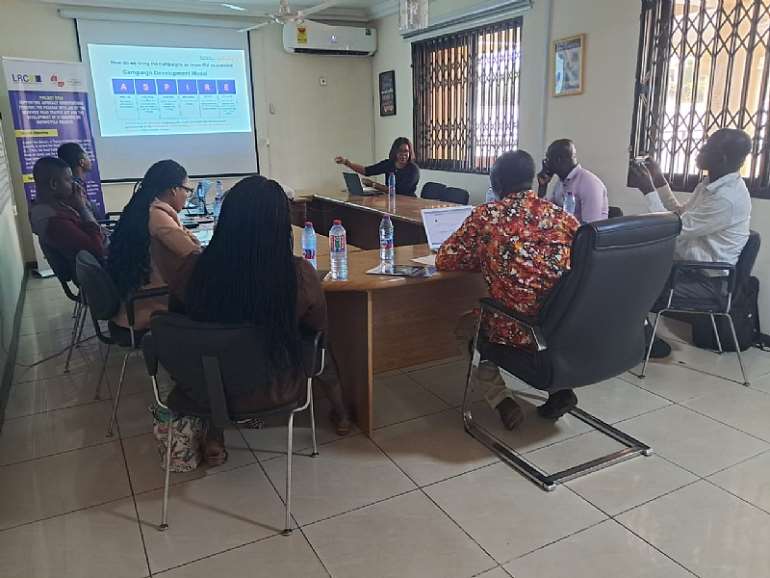
The training also sought to build the capacity of journalists to use both data and human stories to spark public awareness and influence policymakers.
Ms. Mavis Obeng Mensah, Communication Officer of the Bloomberg Initiative for Global Road Safety (BIGRS), encouraged the media to move beyond reporting road crashes as statistics and instead embrace solution journalism.
“Every road crash statistic represents a human life. These are not just numbers they are people, families, and futures. Journalists must help us tell these stories and follow up on what is being done after each crash,” she urged.
Also addressing participants, Mr. Dennis Yeribu, Principal Planning Manager at the NRSA, called on every road user to take personal responsibility for their safety and strictly comply with road regulations.
“The truth is, we cannot leave the responsibility of our safety in anyone else’s hands. We must ensure we obey the basic safety protocols from sticking to speed limits to wearing seatbelts and helmets,” he stressed.
He reminded the public of Ghana’s key speed limits, which must be observed at all times: 50 km/h in built-up areas, 30 km/h in sensitive zones such as schools, and no more than 80 km/h on highways. Mr. Yeribu further advised drivers to ensure that all passengers are properly restrained, while motorcyclists must always wear helmets, avoid overloading, and show consideration to other road users.
“We lose a minimum of eight lives daily to road crashes in Ghana. These are not just statistics they are real people, and the next victim could be anyone,” he warned. “You can be healthy, eat right, exercise, but it takes one bad decision on the road to end a life.”
Addressing enforcement issues, Mr. Yeribu highlighted that Ghana’s Road Traffic Regulations already outline penalties for various offences, including fines of up to GHS 600 or jail terms of up to 30 days for speeding and other violations. Repeat offenders may face both penalties.
“For not wearing seatbelts or helmets, there are penalty units prescribed in the law. Ignorance of the law is no excuse. Every road user must know what the law says,” he stated
He, however, admitted that enforcement remains a challenge, stressing the need for closer collaboration with the Ghana Police Service to ensure stricter compliance.
“Education without enforcement becomes entertainment. People will only take road safety seriously when they see real consequences for violations,” he added.
Mr. Yeribu also appealed for greater logistical and financial support for the NRSA to effectively carry out its mandate.
“Road safety doesn’t come cheap. We need vehicles, technical personnel, and modern equipment to carry out our work effectively,” he said. “We can put systems in place, but if individuals don’t obey, we’ll still be dying. Everyone has a role to play. Let’s take responsibility and make our roads safer for all.”
He commended the media for its continued partnership with the NRSA in spreading awareness and educating the public, adding that their role remains indispensable in shaping safer road practices across the country.
Source: https://www.modernghana.com/news/1436549/legal-resources-centre-engages-journalists-to-cham.html